Pursuing ‘the Art Part’ of Martial Arts
Students
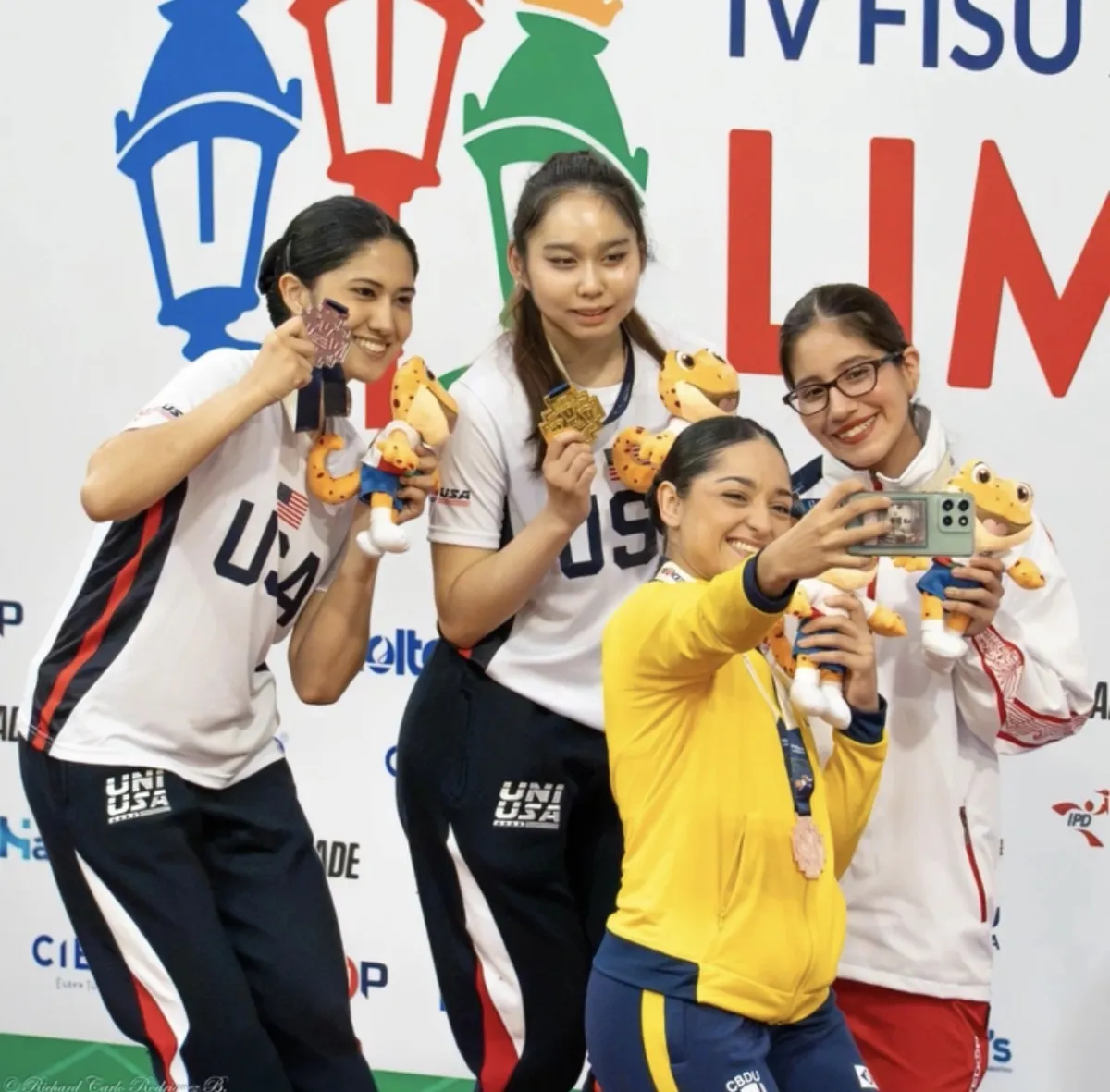
Smith College junior Aahana Mulchandani won a silver medal this summer in an international taekwondo competition

Photo courtesy of the International University Sports Federation
Published August 24, 2026
The sport that Aahana Mulchandani ’28 has been practicing since childhood represents “the art part of martial arts,” she says. “It mixes the strength and tempo of figure skating and dance with the power of fighting.”
Mulchandani is an expert in poomsae, a solo division of the Korean martial art, taekwondo. This summer, she won a silver medal as a member of the U.S. team in the FISU America Games international collegiate competition in Peru.
Making the U.S. team started with tryouts held in California in the spring—during Smith midterms, no less. “I ended up competing with one of my very good friends from the team I train with in New Jersey,” says Mulchandani, who is majoring in psychology at Smith.
In the end, they both made the U.S. team and flew to Lima in July to compete alongside 3,000 other college athletes.
The National Collegiate Taekwondo Association’s poomsae team achieved a historic first in Peru, bringing home golds in every division entered. This was also a first for poomsae, and Mulchandani is elated to have been a part of the team’s overall success.
“I felt a great sense of thankfulness the whole time,” she says of her experience in Peru. “Just knowing I was there representing my school was huge. Smith means a lot to me. And I have a newfound respect for athletes who train and live in conditions that are a lot harder than what we have here in the U.S.”
It was Mulchandani’s mother who signed her up for her first taekwondo class when she was in grade school in California.
“When I was young, I was into Lego Ninjago, and I had told my mom I wanted to be a ninja,” Mulchandani says. “She said, ‘Okay, you can be a ninja, but you need to take a Korean sport because you’re Korean, and that is part of your culture.’”
Over time, Mulchandani became skilled enough in poomsae—which features a set of moves choreographed against invisible opponents—to compete in the U.S. nationals in Austin, Texas, where her family now lives.
In 2018, she qualified for her first World Taekwondo Poomsae Championship in Taipei, Taiwan and in 2025, she won gold in her division in both the U.S. Open Taekwondo Championship in Reno, Nevada, and the Pan American Open in Querétaro, Mexico.
What does it take to be good at her sport?
“I think it takes a very sharp mind,” says Mulchandani, who also has experience coaching poomsae. “You have to be able to move so many body parts at the same time and in a certain way. And you have to do things that our bodies are not automatically hardwired to do—like the more than 180-degree kicks.
“There’s no resistance when you do poomsae, since you’re not hitting any objects, so your body needs to withstand the force of your body’s weight while you’re moving extremely fast,” she adds. “It’s extremely challenging and requires a lot of mental fortitude.”
In official competitions, poomsae practitioners are scored for “accuracy and presentation,” Mulchandani says. “The judges are looking at how well you follow the textbook of the form, while also judging how well you can express yourself.”
Poomsae is not currently an Olympic sport, so events such as the FISU games “are the Olympics for us,” Mulchandani notes. She has two more competitions coming up this season: the World Taekwondo President’s Cup America in Lima in late August, and the USA Taekwondo Season Final in Little Rock, Arkansas in September.
Her mother is still her biggest supporter.
“She’s really knowledgeable about taekwondo,” says Mulchandani. “When I’m home practicing, she records me and helps advise me when things don’t look right. It’s awesome to have her in my corner.”
At Smith, Mulchandani is taking classes in preparation for medical school. She has also taken Korean language classes, which she says have contributed to her appreciation of her culture.
In good news for fellow martial art enthusiasts, Mulchandani is working on setting up an official taekwondo club on campus.
“I want to teach other people about this sport,” she says. “I want to take them to competitions and get them to experience this, too.”